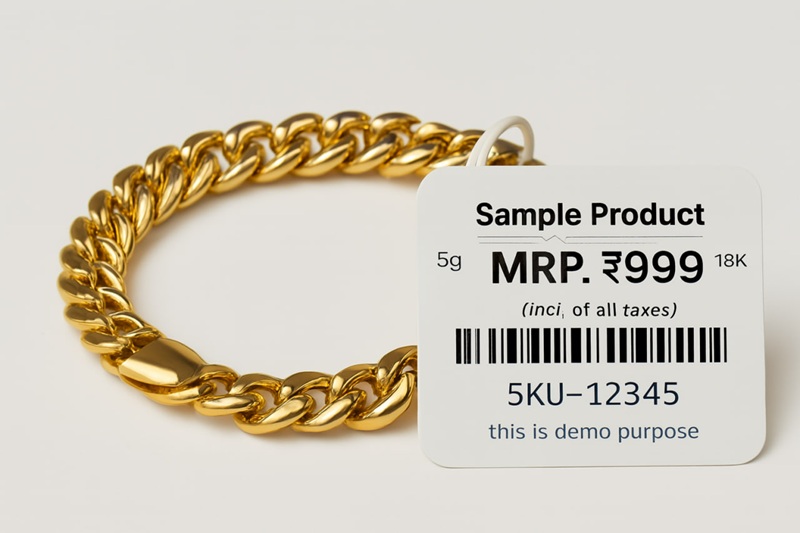
That Tiny Tag on Your Jewelry is Costing You a Fortune. Here's How to Fix It.
I want to take you to Zaveri Bazaar, Mumbai. The heart of India's jewelry trade. It's organized chaos. Millions of dollars in gold, silver, and diamonds move through those narrow lanes every single day. And the entire system, this multi-billion dollar industry, runs on one tiny, unassuming thing: a little paper tag. The first time I saw it up close was in 2014. I was helping a family friend, a third-generation wholesaler, try to 'digitize' his inventory. I walked into his back office, and what I saw was my own personal headache. He had thousands of rings, earrings, and necklaces, each in its own tiny plastic pouch. And on each pouch was a minuscule, handwritten tag with a cryptic code and a price scribbled in ballpoint pen. His 'inventory system'? A massive, leather-bound ledger book where an accountant would manually write down every single transaction. It was a system built on decades of tradition and trust, but it was bleeding money.
“What happens if a tag falls off?” I asked him. He just laughed a sad, tired laugh. “Then we have a very big, very expensive problem, beta.” That problem, I later learned, is called 'inventory shrinkage'. A polite term for theft, loss, and damage. And in the high-value world of jewelry, even a tiny shrinkage rate can be catastrophic. A 2025 global retail security report by Statista found that the jewelry sector has one of the highest shrinkage rates, averaging nearly 2% of annual turnover. For a small jeweler, that’s not just a rounding error; that’s the difference between profit and bankruptcy. And the number one cause of preventable shrinkage? Inaccurate or non-existent item-level tracking. In other words: bad labels.
Look, I've spent 5 years in e-commerce, and while most of my time was spent shipping t-shirts and tech gadgets, my time in the trenches of the Mumbai jewelry market taught me a lesson I'll never forget: when the value of your product is incredibly high, and its size is incredibly small, your labeling system is not a matter of 'organization'. It is a matter of security. Your flimsy, handwritten tag is an open invitation to chaos. It’s a security flaw. It’s a vulnerability. This isn't a guide about making pretty tags. This is the no-BS, street-smart guide to creating a jewellery labeling system that protects your assets, builds customer trust, and makes your business run like a well-oiled machine, whether you're a family jeweler in Jaipur or an Etsy seller in Arizona.
The Four Major Issues of Jewelry Labels (Why Your Current Tags Suck)
- The Illegible Scribble: That handwritten tag with '2.5g, 18k' that you can barely read? A customer can't read it either. It looks cheap. It erodes trust. Worse, it’s easy to alter. A dishonest customer (or employee) can smudge a '2.5' to look like a '2.8'. It introduces doubt into a transaction that must be built on absolute certainty.
- The Adhesive Kiss of Death: You stick a standard paper label onto a beautiful silver ring. When the customer buys it, you peel it off, and it leaves behind a sticky, gummy residue that's impossible to remove. You've just damaged a high-value item and created a terrible customer experience right at the point of sale.
- The 'Guessing Game' Inventory: You have a tray of 50 similar-looking gold rings. None of them have a unique SKU or barcode. How do you do a stock count? You weigh each one, check it against a master sheet, and pray you haven't mixed them up. It's slow, error-prone, and a recipe for disaster. A 2024 report by the National Retail Federation (NRF) found that manual inventory counts have an error rate as high as 15-20%, which is unacceptable for high-value goods.
- The Information Black Hole: Your tag only has a price. Where's the weight? The purity? The stone quality? The legally required HUID in India? A lack of information makes customers suspicious and can land you in regulatory hot water.
The Anatomy of a Perfect Jewelry Label: The 'Dumbbell' of Truth
So what does a good jewelry label look like? Forget everything you know about standard rectangular stickers. The professional standard in the jewelry industry is a special kind of label called a 'dumbbell' or 'butterfly' tag. It's a single label with two adhesive ends and a thin, non-adhesive 'strap' in the middle.
How it works: You loop the non-adhesive strap around the ring, chain, or earring post. Then, you fold the label so the two adhesive ends stick to each other, creating a secure, two-sided tag that hangs freely. Crucially, no adhesive ever touches your precious metal or gemstone. This is the single most important innovation in jewelry labeling, and if you're not using it, you're living in the dark ages.
What MUST be on that tag?
| Element | Why It's Non-Negotiable |
|---|---|
| Product ID/SKU | Your unique internal code for that specific piece (e.g., RNG-001-SZ7). |
| Barcode | The scannable version of the SKU. This enables one-second checkout and inventory scans. |
| Weight | e.g., 'Gross Wt: 5.20g', 'Net Wt: 5.15g'. This is fundamental for valuation. |
| Purity | e.g., '22K 916', '18K 750', 'Sterling Silver'. This is a legally required and trust-building element. In India, including the HUID (Hallmark Unique ID) is becoming mandatory. |
| Price (MRP) | The final retail price. Must be clear and unambiguous. |
The Free, Scalable System: How to Go from Chaos to Control
Step 1: Your Digital Ledger (The Google Sheet)
This replaces the old, dusty ledger book. Create a Google Sheet or Excel file. This is your new 'single source of truth'. Every single piece of jewelry in your inventory gets its own row. No exceptions.
Essential Columns:
- SKU (e.g., ERG-DI-001)
- ProductName (e.g., 'Diamond Stud Earrings')
- Weight_Grams (e.g., 1.5)
- Purity (e.g., '14K')
- StoneDetails (e.g., '0.10ct Diamond, VS1')
- CostPrice
- MRP
- HUID (for Indian sellers)
- Status (e.g., 'In Stock', 'Sold', 'In Repair')
This spreadsheet is your new bible. Every piece is tracked from the moment it enters your inventory to the moment it's sold.
Step 2: Bulk Generating Your Tags (The Time-Saving Magic)
Now you need to get the information from your spreadsheet onto a physical dumbbell tag. Doing this one by one is a recipe for insanity and typos. You need to do it in bulk.
The Workflow:
- Export Your Data: Save the sheet for your new inventory as a CSV file.
- Use a Dedicated Tool: Find a free online generator designed for this. The jewelry label maker I built on this site is specifically formatted for common dumbbell tag sizes.
- Get the Template: Download the tool's 'Sample CSV'. This is your cheat sheet. It will have the exact column headers the tool needs (SKU, Weight, Purity, Price, etc.).
- Map and Upload: Copy the data from your digital ledger and paste it into the correct columns of the sample template. Save it. Now, upload this file to the generator.
- Generate the PDF: The tool will instantly create a PDF perfectly formatted for your thermal printer, with each tag containing the unique information for each piece of jewelry.
The Non-Negotiable Hardware: A Thermal Printer
I'm going to be blunt. If you are selling jewelry, you cannot use an inkjet or laser printer for your tags. You just can't. The labels are too small, the ink can smudge, and you can't print on the special dumbbell tag media. You absolutely, positively must have a direct thermal printer. It's not an optional upgrade; it's a foundational piece of equipment, as essential as a jeweler's scale. Why?
- Precision: It can print incredibly crisp, clear text and barcodes on very small labels.
- Durability: The print is created with heat. It will not smudge if a customer handles it. It's permanent.
- No Ink/Toner: Your only cost is the labels themselves, which is crucial for profitability.
- Specialty Media: It's the only type of printer that can handle the rolls of dumbbell-style jewelry tags.
Personal Story #2: The Etsy Seller Upgrade (USA, 2022). I was advising an Etsy seller in Arizona who made beautiful, handcrafted silver rings. She was handwriting her tags. Her inventory was a mess, and her packaging looked unprofessional. She was hesitant to spend the money on a thermal printer. I convinced her to buy a budget-friendly MUNBYN printer (around $160) and a roll of dumbbell tags. The difference was night and day. She used our free online tool to bulk-print tags for her entire collection. Her stock-taking time went from two days to two hours (using a cheap USB barcode scanner). Her checkout process at craft fairs became a one-second beep. And her customer feedback immediately improved. They mentioned how 'professional' and 'trustworthy' her setup looked. That $160 printer paid for itself in saved time and increased sales within a month. For more printer options, my guide to budget thermal printers is a great resource.
The 'Protect Your Assets' Final Checklist
Before you put another piece of jewelry out for sale, run through this mental checklist. It will save you from theft, errors, and angry customers.
- Is Every Single Item Tagged? No exceptions. If it doesn't have a tag, it doesn't go in the display case.
- Is it a Dumbbell Tag? Are you using a proper jewelry tag that doesn't put adhesive on the product?
- Is There a Barcode? Is the SKU represented by a scannable barcode to eliminate manual entry errors?
- Is the Information Correct? Does the weight, purity, and price on the tag EXACTLY match your digital ledger?
- Is it Legible? Is the print crisp and easy to read? If not, you need to clean your thermal printer's printhead.
- Have You Done a Test Scan? Print one label and scan it with a barcode reader app on your phone. Does it instantly pull up the correct SKU? If not, something is wrong.
Look, selling jewelry is a business of trust. Every single thing you do, from the quality of your craftsmanship to the clarity of your pricing, either builds that trust or erodes it. A sloppy, handwritten tag erodes it. A clean, professional, barcoded dumbbell tag builds it. It tells the customer that you are a serious professional who cares about the details. It tells your employees that every item is tracked and accounted for. And it tells your accountant that your inventory numbers are real.
Stop treating your labels like an afterthought. They are the guardians of your most valuable assets. Implement a proper system. Use the right tools. It's a small investment of time and money that will pay massive dividends in security, efficiency, and peace of mind.