The 'Discount' on Your Price Tag is Probably Losing You Money. Here's How to Fix It.
I want to tell you about the most painful lesson I ever learned in retail. It was 2014, and I was running a pop-up shop in a trendy Los Angeles market, selling my handmade leather goods. I was proud of my work, but I was nervous about my prices. I thought my $100 wallet was too expensive. So, I had a 'brilliant' idea: a big, store-wide '25% OFF!' sale. I scrawled it on a huge sign. I felt like a marketing genius. And you know what happened? Nothing. People would walk in, glance at the sign, pick up a wallet, look at the original price tag, and then just... leave. My sales were actually worse than the week before. I was baffled and demoralized.
The next day, an older, wiser vendor from the stall next to me—a woman who sold antique jewelry and had seen it all—pulled me aside. She looked at my sad little setup and said, 'Kid, you're doing it all wrong. Nobody believes a generic, store-wide sale. It just makes everything look cheap. You're not selling a discount; you're selling a story. Go back tonight, take down that desperate sign, and for every single product, create a new tag. Show them the old price, crossed out, right next to the new price. Make them feel the deal.' I thought it was pointless, but I was desperate, so I did it. I spent hours that night creating new tags: '$100 $75'. The next day, I sold more wallets than I had in the entire previous week. The price was the same. The discount was the same. The only thing that changed was the presentation. That was the day I stopped thinking about price and started thinking about pricing psychology. And it changed my business forever.
Look, after 5 years of selling everything from spices in Mumbai to software in California, I can tell you this: the price tag is the most powerful, and most misunderstood, piece of marketing material you own. A well-designed discount label doesn’t just state a new price; it tells a story of value, urgency, and opportunity. A bad one just screams 'desperate' and devalues your entire brand. A 2024 study by Statista on consumer psychology confirmed that pricing presentation and clarity were ranked as one of the top three factors influencing in-store purchase decisions, right behind product quality and availability. This is the no-BS guide to creating and using MRP and discount labels that actually work. No fluff, just the street-smart psychology and free tools you need to stop losing money and start making your price tags work for you.
The Fatal Flaw of the Generic 'SALE' Sign
My LA pop-up story isn't a fluke. It’s a classic example of a universal consumer psychology principle. A generic, store-wide '25% OFF' sign is weak for a few key reasons:
- It Lacks Credibility: Modern consumers are cynical. They’ve been trained by decades of retail shenanigans to assume that a generic sale sign often means the original prices were inflated just so they could be 'discounted'. It feels inauthentic.
- It Forces Mental Math: 'Okay, so this shirt is ₹1,200, and it's 25% off... so that's... uh...'. You're making the customer do work. In the fast-paced world of retail, any friction, even mental friction, can stop a sale. A Baymard Institute report from 2025 on checkout optimization highlighted that unexpected costs or unclear pricing is a top-three reason for cart abandonment online. The same principle applies in-store.
- It Devalues Your Brand: A permanent 'SALE' sign makes your brand look cheap. It trains your customers to never pay full price, eroding your margins and your perceived quality.
A specific, item-level discount, on the other hand, feels intentional. It feels like a genuine, limited-time opportunity on that specific product. It’s a targeted action, not a desperate carpet-issues.
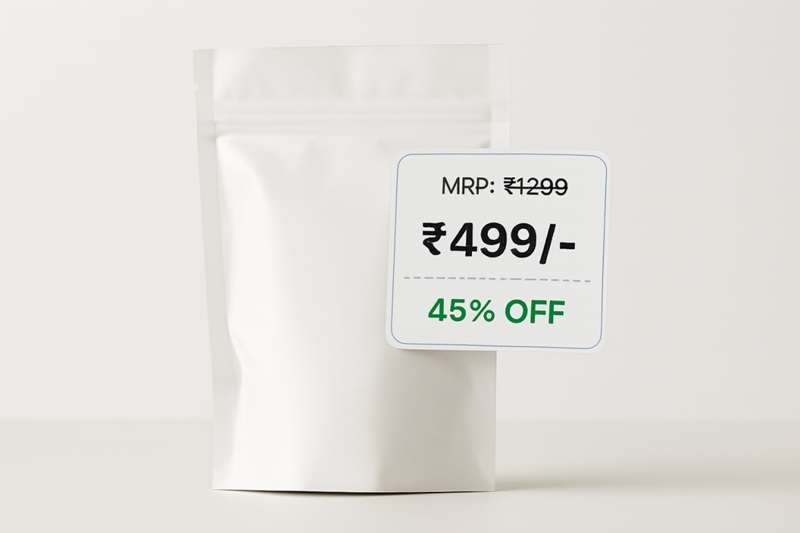
The Anatomy of a High-Conversion Discount Label
| Element | Example | Psychological Job |
|---|---|---|
| 1. The Anchor Price (MRP) | This is the first number they see. It 'anchors' their perception of the product's value. The higher, the better. | |
| 2. The Sale Price | ₹1,999 | This is the 'deal'. It should be bold and visually dominant. The contrast with the anchor price creates the feeling of a win. |
| 3. The Justification | (20% OFF) or 'FESTIVE OFFER' | This gives them a reason why it's on sale. It makes the discount feel legitimate and temporary, creating urgency. |
| 4. The Product Identifier | 'Diwali Celebration Gift Box' | Reminds them what this amazing deal is for. |
Personal Story #2: The Diwali Sale Miracle (India, 2021). I ran this exact A/B test on my own D2C website for a popular gift box. For one week, the price was just a simple '₹1,999'. The next week, I changed the display to show '₹2,499 ₹1,999 (20% OFF)'. The actual price the customer paid was identical. The conversion rate on that product page more than doubled during the second week. It wasn’t a better price; it was a better story about the price. This is pure pricing psychology in action, and it works just as well on a physical tag in a store as it does on a website. It’s why tools like the free MRP and discount label maker makes this even cleaner.
The Indian Angle: The Mighty MRP and Why It's Your Best Friend
For my American seller friends, this might be a new concept. In India, almost every packaged product is legally required to have a Maximum Retail Price (MRP) printed on it. This was originally a consumer protection law to prevent price gouging. But as a seller, you can use it to your psychological advantage. The MRP is a government-mandated anchor price! It’s the ultimate form of price credibility. When you offer a discount below the MRP, it’s not just you saying it’s a deal; the government has implicitly co-signed the product's original value. A study by the E-commerce Intelligence Centre in 2023 on Indian consumer behavior found that discounts shown relative to the MRP had a 40% higher trust factor than discounts without a visible MRP. Always, always, always show the MRP on your Indian price tags.
Personal Story #3: The Kirana Store Showdown (Mumbai, 2022). I was helping my local kirana store owner, a sweet man named Mr. Patel, compete with the big grocery apps like Zepto and Blinkit. They were losing customers. We noticed that his store was full of products, but the pricing was just handwritten stickers with a single number. We spent a weekend re-labeling a key aisle of high-margin snacks. Using a simple thermal printer and an online label generator, we created new tags that clearly showed the official MRP (crossed out) and his slightly lower price next to it. For example: 'Lays Magic Masala - MRP ₹20 Our Price ₹18'. His sales in that aisle jumped 25% in a week. Customers felt like they were getting a deal, a small win, every time they picked up a bag of chips. It changed the entire feeling of his store from 'convenient' to 'smart'.
The 'How-To' Guide: Creating Bulk Discount Labels for Free in Under 5 Minutes
Okay, theory is great. But what about when you have to run a sale on 200 different products? Are you going to design 200 different labels in Canva? Heck no. Your time is more valuable than that. You need a system. As I preached in my guide to bulk label printing, the answer is always a spreadsheet.
The Bulk Discount Label Workflow:
- Create Your Sale Sheet: This is your command center. Open Google Sheets or Excel. You need four columns: SKU, MRP, DiscountedPrice, and OfferText.
- Populate Your Data: Fill it out for every product going on sale. The 'OfferText' could be '20% OFF', 'SALE', 'Clearance', etc. This is your chance to control the narrative for each product.
- Use a Dedicated Tool: Find a free online label generator that's built for this. Go to the 'MRP & Discount Label' template.
- Download the Sample CSV: This is the cheat sheet. The tool will provide a template with the exact column headers it needs.
- Map and Upload: Copy the data from your sale sheet and paste it into the correct columns of the sample template. Save it. Now, upload this file to the generator.
- Generate & Print: The tool will instantly create a multi-page PDF with every single one of your discount labels, perfectly formatted with the strikethrough, bold new price, and offer text.
Choosing Your Tool: Thermal vs. Laser for Price Tags
When it comes to printing these tags, you have two good options. As I detailed in my definitive printer guide, inkjets are a non-starter due to cost and smudging.
Laser/Inkjet with A4 Sheets: The Starter Pack
This is where most people begin. You use your existing office printer and A4 sticker sheets. It works perfectly fine, especially with the bulk PDF you just generated.
Pro-Tip: Choose a smaller label size, like 40x25mm. You can fit a huge number of them on a single A4 sheet, making it incredibly cost-effective. A single sheet of labels might cost ₹5, but if you get 50+ labels out of it, your per-label cost is only ₹0.10.
Thermal Printer: The Professional's Choice
If you're running a physical retail store and changing prices or running promotions frequently, a thermal printer is not a luxury; it is a necessity. Why?
- Speed: Need to print just one tag for a new product? A thermal printer spits it out in a second. No wasted sheets.
- Cost: Your only consumable is the label roll. The cost per label is pennies (or paisa).
- Durability: Thermal prints don't smudge or fade. They look crisp and professional all day, every day.
- Specialty Media: You can get special thermal tags like jewelry 'dumbbell' labels that don't use adhesive on the product itself.
Investing in a budget thermal printer (like the ones I recommend in my best budget thermal printers guide) will pay for itself within months in time and supplies saved.
The 'Stop Losing Money' Final Checklist
| The Check | The 'Why It Matters' |
|---|---|
| Clarity First: Can a customer read the price from 3 feet away? If not, it's too small. | A customer should never have to squint to figure out how much something costs. |
| Consistency is Key: Are all your tags in the same format and font? A consistent look builds trust. | A mix of different styles looks messy and unprofessional. |
| Barcode Test: Print one tag and scan the barcode with your phone's camera or a scanner app. Does it work instantly? If not, something is wrong. | An unscannable barcode defeats the purpose of having one and slows down checkout. |
| No Surprises: Does the price on the tag match the price in your checkout system? A mismatch is the fastest way to annoy a customer. | Price discrepancies lead to arguments at the counter and lost sales. |
| Context Matters: Is the design appropriate for the product? A luxury item deserves an elegant tag. A fun, quirky product can have a more playful one. | The design of the tag should reinforce the brand identity, not contradict it. |
Look, your price tag is the sharp end of your entire business strategy. It’s where all your sourcing, marketing, and branding efforts either succeed or fail. Stop treating it like a boring administrative task. Start treating it like the powerful psychological tool it is. Be strategic, be clear, and be intentional. It's a small piece of paper that can make a massive difference to your bottom line.