Your Thank You Cards Are Garbage. Here’s How to Create Packaging Inserts That Actually Increase Repeat Orders.
I want you to think about the last ten things you bought online. Not from Amazon, but from a real, independent brand. I want you to picture the unboxing. You open the boring brown mailer, and inside is your product. And what else? Probably nothing. Or maybe, just maybe, a sad, flimsy little business card with a generic “Thank You For Your Order!” printed on it. You glance at it for 0.7 seconds, feel absolutely nothing, and toss it straight into the trash with the bubble wrap. Sound familiar? Of course it does. Because that’s what 99% of e-commerce sellers do. And it is, without a doubt, the single most lazy, wasteful, and unimaginative marketing decision you can possibly make.
Look, after 5 years of shipping products from both the US and India, I’ve come to a fundamental truth: the moment a customer opens your package is the most intimate, high-attention moment you will ever have with them. They are excited. They are engaged. Their brain is flooded with dopamine. You have their undivided attention. And what do most brands do with this golden opportunity? They shove a piece of trash into the box that the customer is psychologically conditioned to ignore. It’s like getting a primetime Super Bowl ad slot and using it to show a picture of your cat. It’s a colossal waste.
This isn't a guide about being 'cutesy'. This is a guide about being a ruthless marketing strategist. We’re not talking about just saying 'thank you.' We’re talking about using that tiny piece of paper or sticker to hijack your customer's brain, build a real connection, and directly increase your repeat purchase rate. I’ve run the experiments, I’ve tracked the data, and I’ve seen the results. A well-executed packaging insert strategy is not an expense; it’s one of the highest-ROI marketing channels you have. And today, I’m going to give you the exact, no-BS playbook to do it right, for free, whether you’re selling to customers in California or Kolkata.
The Psychology of the Unboxing: Why Your Brain Hates Boring Inserts
First, you have to understand why the generic thank-you card fails. It’s a concept called 'schema'. Your brain is a pattern-recognition machine. It creates mental shortcuts (schemas) to deal with the world efficiently. When you see a generic, low-effort business card in a package, your brain instantly activates the 'junk mail' schema. It recognizes it as low-value, impersonal corporate fluff and immediately categorizes it as 'to be discarded'. You don't even consciously decide to throw it away; your brain does it for you. A 2023 study by The Packaging School found that consumers spend an average of fewer than 2 seconds looking at standard printed inserts before discarding them.
Your mission, should you choose to accept it, is to break that schema. You have to create an insert that doesn't feel like marketing material. It has to feel like a gift. It has to provide unexpected value. It needs to trigger curiosity, not indifference.
The “Value-First” Framework: Four Insert Strategies That Actually Work
1. The “Secret Knowledge” Insert
Personal Story #1: The Spice Brand Experiment (India, 2021). I was running a D2C brand selling premium, single-origin spices in India. Our packaging was beautiful, but we had no way to bring customers back. We started including a small, nicely designed card in every order. On one side, it said, “Thank You for Trusting Us.” But on the other side, it said: “Unlock Our Founder’s Secret Chicken Curry Recipe” with a QR code.
The results were insane. Over 40% of customers scanned that code. Why? Because it wasn’t an ad. It was a gift of exclusive knowledge. It created an 'insider' feeling. And that QR code? It didn’t just go to a recipe. It went to a hidden landing page on our Shopify store. The page had:
- A personal video from me, thanking the customer and explaining the story behind the spice blend they just bought.
- The “secret recipe” as promised.
- A one-time-use, 15% discount code for their next order that expired in 30 days.
That simple card directly led to a 22% increase in our repeat customer rate within three months. We used a free tool like the free QR code generator on SmartLabelPrint to create these codes in seconds.
How to Apply This:
- For Food/Beverage Brands: Offer a secret recipe, a pairing guide, or a 'pro-tip' for using the product.
- For Skincare/Beauty Brands: Provide a '5-step ritual for a perfect glow' or 'How to get the most out of your serum'.
- For Apparel Brands: A QR code linking to a '3 Ways to Style This Piece' lookbook or video.
- For Home Goods: A guide on 'How to Care For Your Item' to make it last a lifetime.
You're giving them value that enhances the product they just bought. The thank you is implicit; the value is explicit.
2. The “Personal Story” Insert
People don't connect with logos; they connect with other people. Especially in the small business world, your personal story is your single biggest competitive advantage against faceless giants like Amazon. You need to tell it.
Personal Story #2: The Leather Goods Connection (USA, 2022). I was helping a friend launch a brand of high-end, handmade leather wallets on Etsy. The products were expensive. We needed to justify the price and build a connection. Instead of a generic card, we printed a small, postcard-sized insert. On one side was a high-quality photo of the founder, a rugged-looking guy named Dave, actually working with the leather in his workshop. On the other side was a short, handwritten-style note:
“I’m Dave. I’m the guy who chose the leather for this wallet. I’m the guy who cut it, stitched it, and checked it for flaws. This isn’t a factory product; it’s a piece of my craft. I hope you love using it as much as I loved making it. If you ever have an issue, you’re not calling a customer service line; you’re not calling me.”
The impact was immediate. Our review quality shot up. People stopped talking about the 'product' and started talking about 'Dave's wallet'. They felt like they had bought something from a real person, an artisan. This strategy helped us maintain a 5-star rating and become a top seller in a crowded category. A 2021 Stackla report found that 79% of people say user-generated content (like authentic stories) highly impacts their purchasing decisions. Your story is your most authentic content.
How to Apply This:
- Write a short, authentic note about why you started your business.
- Include a photo of yourself or your team. Let them see the humans behind the brand.
- Hand-sign them if you can, even if it's just your first name. That little bit of ink makes a huge psychological difference.
3. The “Social Proof & UGC” Insert
You want more user-generated content (UGC)—customers posting photos of your products on social media. It’s the most powerful marketing you can get. But you can't just hope for it; you have to ask for it. And you have to make it easy.
The Workflow:
- Create a simple, visually appealing card. The headline should be a clear call to action: “Show Us Your Style! Get Featured.”
- Clearly state the instructions: “1. Snap a photo of your new Product. 2. Post it on Instagram & tag @YourBrand. 3. We'll feature our favorites and send you a surprise gift!”
- Include your social media handle in a large, easy-to-read font.
This works because it offers a clear incentive (getting featured, a surprise gift) and tells them exactly what to do. It gamifies the post-purchase experience. This is especially effective for visual products like fashion, home decor, and beauty.
4. The Strategic Sticker: Branding Beyond the Box
Sometimes, the best insert isn't a card at all. It's a sticker. But not just any sticker. I’m not talking about a sticker of your logo. Nobody wants to be a walking advertisement for you (unless you’re a cult brand like Supreme). The sticker itself has to be cool. It has to be something they’d want to put on their laptop, water bottle, or notebook.
Personal Story #3: The Sticker That Stuck (USA, 2017). I was selling outdoor gear. We designed a simple, beautifully illustrated sticker of a mountain range with our brand name subtly integrated at the bottom. We just threw one into every order. We never asked people to use them. But they did. We started seeing them pop up in photos from hiking trails, on the back of camper vans, on laptops in coffee shops. Each sticker was a tiny, mobile billboard. It created a sense of community, a tribe. It was marketing that didn't feel like marketing.
How to Apply This:
- Invest in good design. Hire a real illustrator on a platform like Upwork or Fiverr.
- The design should reflect the lifestyle of your customer, not just your logo.
- Keep your branding subtle. Let the cool design be the hero.
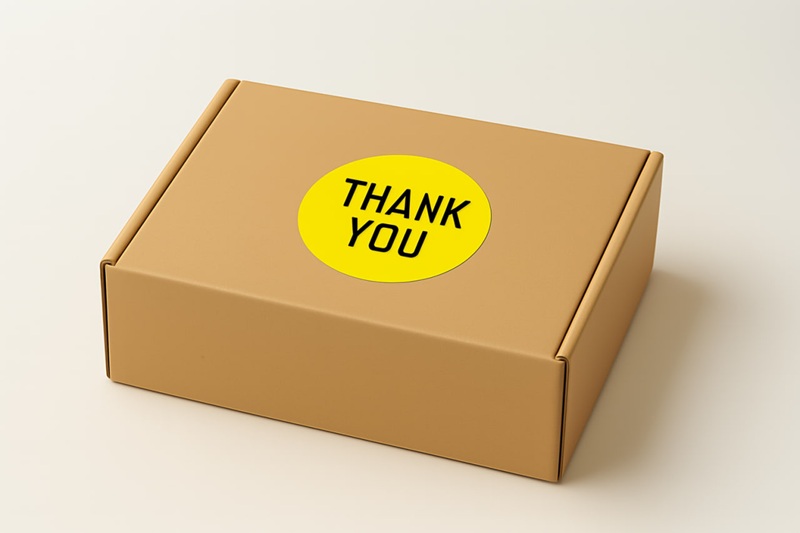
And you don't need a huge budget. For smaller touches, you can use a free tool like the thank you sticker generator on SmartLabelPrint to create simple, branded labels to seal your tissue paper or add a final touch to your box. The key is to add a layer of thoughtfulness.
The Repeat Order Cheat Sheet: Which Strategy for Which Business?
| Your Business Type | Best Insert Strategy | Why it Works |
|---|---|---|
| Food, Beverage, Spices | Secret Knowledge (Recipe/Pairing Guide) | Provides immediate, tangible value that enhances the product itself. |
| Handmade, Craft, Etsy | Personal Story (Founder Note) | Builds a powerful emotional connection and justifies a premium price. |
| Fashion, Apparel, Decor | Social Proof (UGC Campaign) | Leverages the visual nature of the product and encourages community building. |
| Lifestyle, Outdoor, Hobby | Strategic Sticker (Cool Design) | Creates a 'tribe' and organic, word-of-mouth marketing. |
Final Pro Tips from the Trenches
- Print Quality Matters: Don't design a beautiful insert and then print it on flimsy, cheap paper with a dying inkjet printer. For cards, use a decent cardstock (at least 250gsm). For stickers, use a good quality vinyl or paper stock. Your insert is a representation of your brand's quality. A 2022 survey by Lombard found that 40% of consumers are more likely to make a repeat purchase from an online merchant with premium packaging.
- A/B Test Your Offers: Don't just assume what will work. For one month, offer a 15% discount code. The next month, try a 'Free Shipping on Your Next Order' code. Track which one gets more redemptions. Data, not feelings.
- Don't Forget the Shipping Label Itself: While you're thinking about branding, don't neglect the outside of the box. A professional, clear shipping label is part of the experience. A handwritten, messy label can undermine all the good work you did inside. Use a proper tool to generate clean labels. For a detailed guide on this, check out my post on printing bulk shipping labels.
- Personalize When You Can: If you're still at a manageable scale (under 30-40 orders a day), take 10 extra seconds to hand-write the customer's first name on the card. 'Hi Sarah,' is infinitely more powerful than 'Valued Customer'. This small act has a massive psychological impact.
Conclusion: Stop Leaving Money on the Table
The bottom line is this: your packaging insert is not a cost center. It's a marketing asset. It’s your chance to speak directly to your customer at the moment they are most receptive to your brand. Stop treating it like an afterthought. Stop throwing garbage in a box and hoping for the best. Be strategic. Be valuable. Be human. Ditch the generic thank you card and start building a real, profitable relationship with the people who keep your business alive. It's the cheapest, most effective marketing you'll ever do.